
5 Climbing Tips That Actually Move the Needle
Most climbers aren't weak — they're just training the wrong things, in the wrong order, and misreading why they fail. Here's what the data and the best coaches actually say.
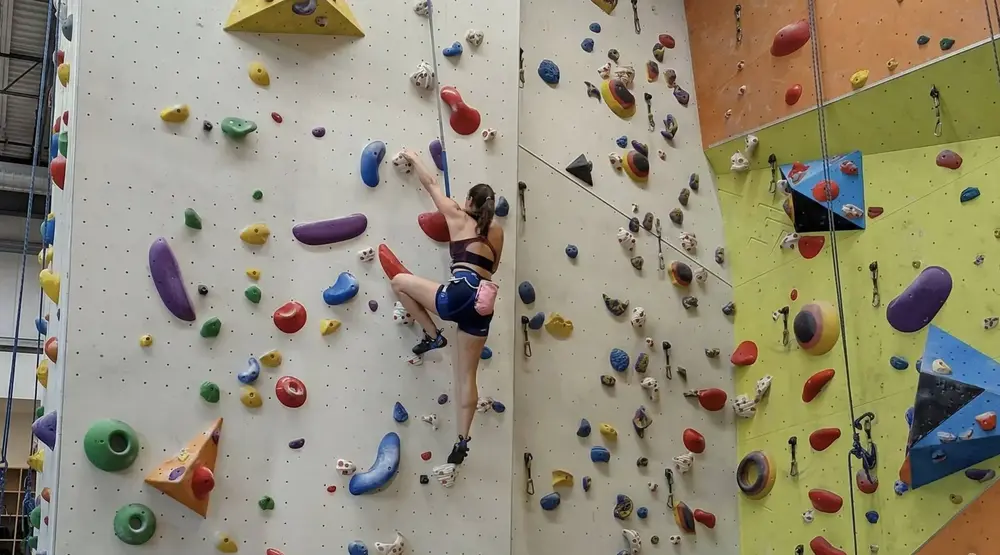
I had a training plateau that lasted longer than I want to admit. I was getting stronger — my max hang performance improved, weighted pull-ups got easier. But on the wall, almost nothing changed. The same moves stopped me. The same routes felt just as hard.
The shift came when I fell in love with training on a Kilter Board — actually doing limit bouldering instead of structured off-wall routines. Within a few months, I made a bigger jump than I had in a long time. Not because I got stronger, but because I finally started training in a way that transferred.
What follows are five things I wish I'd known earlier — grounded in data, research, and coaches who've studied this more carefully than most.
Do Your Hardest Training First
This sounds obvious. Most climbers do the opposite.
The pattern Lattice Training coaches observe most often: climbers warm up, do their "fun" climbing, then add hangs or campus work at the end as an afterthought. The problem isn't discipline — it's physiology.
The Rule
Whatever requires maximum effort or maximum load — hangboard, campus board, limit bouldering — goes first in the session, after a proper warm-up. Everything else follows. Not the other way around.
There's also an injury angle that's easy to overlook. Finger pulleys are most vulnerable when fatigued. Doing max-load work at the end of a session is the exact scenario where A2 strains happen. Most serious training programs build this order in as a hard rule, not a preference.
Train with Intention — Not Just “Go Climbing”
Most climbers don't really train. They just climb. And while climbing is always useful, showing up without a clear goal means you're likely doing everything at medium intensity — hard enough to fatigue, not hard enough to actually adapt.
Research from Lattice Training (436 sport climbers, 6c–9b+) shows that the physical attributes which best predict performance are max finger strength and Critical Force — your forearm's ability to sustain repeated hard efforts. The interesting part: which of the two matters most shifts significantly depending on your current level.
📖 Coming soon: Finger strength vs. Critical Force — what actually limits YOU at your level →The practical takeaway: most climbers aren't deliberately training either one. They do a bit of everything and wonder why progress stalls. The fix is to walk into every session knowing two things: what type of training you're doing, and what specific thing you're trying to improve.
"Limit bouldering" is a session type — not an intention. A real intention looks like this:
Session + Intention Examples
Limit Bouldering → Focus: tension and hip engagement on overhangs. Every attempt, actively think about keeping your hips close to the wall — don't let them sag.
Limit Bouldering → Focus: don't cut feet. If your feet come off, that's the data — not the fall.
ARC Session → Focus: silent feet. 15–20 min of continuous climbing — one precise placement per move, every move.
Naming the specific thing before you pull off the ground is what separates deliberate practice from just burning energy. Research in sports psychology shows that specific if-then intentions consistently outperform general effort goals — especially under fatigue, when you default to old habits.
Simple Weekly Framework
1× Max Strength — Limit bouldering or max hangs. Full recovery between efforts. Only works when fresh.
2× Power Endurance — 4×4s, circuits, sustained climbing at your limit. Trains your ability to keep performing hard moves without full recovery.
1× ARC Training — Easy, continuous climbing (15–20 min) just below the pump threshold. Builds your forearm's aerobic base and racks up far more technique mileage than a projecting session. Two elite coaches who had climbed 8c+ discovered their ARC pace sat at 6a — their redpoint grade had masked how shallow their aerobic base actually was.
Stop Misdiagnosing Your Weaknesses
You fall off a crux. You assume it's a strength problem. You spend two weeks training. You come back. You fall off the same crux again.
Kris Hampton of Power Company Climbing has been making this point for years: most failures on specific moves aren't strength failures — they're familiarity failures. You haven't spent enough time on that exact move to know the right body position, where to place your feet, how much to trust the hold. The solution isn't more training — it's more attempts, with real attention to what's going wrong.
“Weaker climbers have done this route. It's rarely the finger strength.”
— Dave MacLeod
This doesn't contradict the finger strength data — it just means the two things operate at different levels. Systematic weaknesses that show up across many routes and styles require targeted training. But a single crux you keep falling off almost always just needs more focused attempts: slow down, look at your feet, try a different sequence, find the right hip position. Three sessions on the actual problem beats two weeks in the climbing gym.
Quick Self-Check
Before diagnosing a weakness: have you tried this specific move more than 10 times, with full attention to body position and footwork? If not, go back to the wall first. The training can wait.
G-Tox: Stop Shaking Your Arm the Wrong Way
Almost every climber shakes out the same way: hang the arm down, shake loosely. It feels right. It's not particularly effective.
A study on grip recovery between hard moves found that the G-Tox technique — alternating the arm between raised above the head and dropped below the hip, repeated for 10–15 seconds — produced 18% grip recovery. Standard passive arm-hanging: around 2%.
It takes about two sessions to make it automatic. After that, it costs nothing and works on every rest hold — on the wall and outdoors.
There's a lot more to say about recovery and pacing in climbing — including the flash pump, work:rest ratios, and CNS fatigue.
→ Want to go deeper on recovery science? G-Tox & Recovery Pacing: The Science Behind Getting UnpumpedTry this in NextGrade — it's free
All features are free. Create your account and start training.
Getting Stronger Isn't Enough — You Have to Apply It
This is the one most training articles don't say clearly enough — and it's exactly the trap I fell into.
After a focused strength block, your body gets stronger. But your movement patterns on the wall don't automatically update. You've spent years learning to move in ways that worked at your old strength level. Those habits are deeply ingrained — and they don't disappear just because your max hang improved.
Nathan Drolet of Power Company Climbing frames it simply: new strength opens doors. But you have to consciously walk through them. After a strength block, dedicate sessions on the wall to one goal: explore movements you couldn't access before. Try body positions you would have avoided. Reach for holds that used to feel out of range. Don't default back to what worked before.
“Climbers will dedicate years to getting strong enough when what they really need is to learn how to apply the strength they already have.”
— Nathan Drolet, Power Company Climbing
This is what the Kilter Board did for me. It didn't just build strength in isolation — it forced me to express that strength inside real climbing movement, in the positions climbing actually demands. The training and the application happened at the same time. That's why it transferred when everything else hadn't.
📖 Source: Nathan Drolet — Why Strength Training Isn't Making You Climb HarderThe Common Thread
All five tips point at the same underlying problem: most climbers train and climb without enough intention. They show up, get tired, go home. Repeat. Progress stalls.
The fix isn't doing more. It's doing the right things in the right order — train max strength first, structure your sessions around a clear goal, diagnose failures honestly, recover smarter, and after you get stronger, actually climb differently.
Pick one of these five. Apply it for the next four sessions. That's enough to know whether it's real for you.
Train with a plan that adapts to you
NextGrade builds personalized climbing training plans around your level, goals, and schedule. All features are free — no credit card required.
🧗 Open NextGrade — it's free →Create your account and start training today.