
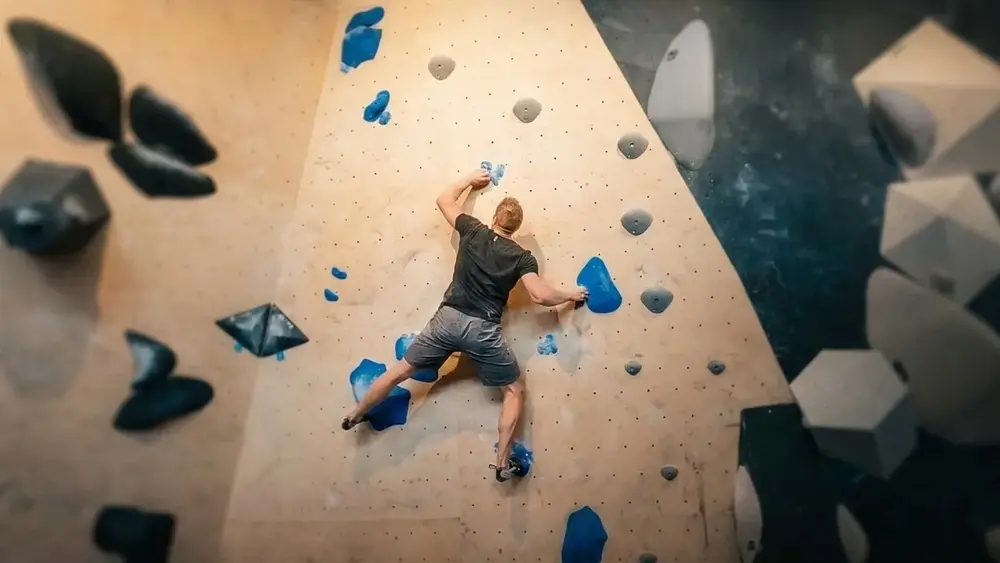
The Truth About Why You're Stuck
You've been training on the hangboard twice a week. Your finger strength has gone up. But your sending level? It's still the same.
Here's the uncomfortable truth: your fingers are strong enough. Your movement isn't.
I've been there. After my finger tendon rupture three years ago, I had to rebuild everything from scratch. No hangboard, no campus board—just movement work. And you know what happened?
My climbing felt more efficient, my footwork improved, and I finally understood how to use my body instead of just pulling with my arms. That's what this article is about. Not another finger strength protocol. This is about movement training—the missing piece in 90% of climbers' training.
Why Movement Matters More Than You Think
Why Most Climbers Plateau (And What Actually Fixes It)
The typical climber's training often looks like this:
- Hangboard session
- Pull-ups
- Maybe some core work
- Climbing a few times a week
This approach is fine for beginners. However, at some point, finger strength gains plateau. You might have maxed out your connective tissue adaptation. You're spending hours training strength, but the bottleneck was never your fingers in the first place.
The real bottleneck is how you move on the wall.
Every second you spend with sloppy footwork, inefficient body positions, and hesitation between moves—that's time you're not improving. In fact, you're often reinforcing bad habits.
The climbers who break through aren't always the strongest. They're the ones who move smarter.What Movement Training Actually Means
When we talk about movement training in climbing, we're not talking about flexibility or yoga. Instead, we're focusing on the specific motor patterns that make you efficient on rock and plastic.
It includes crucial elements such as:
- Footwork precision – Getting your foot exactly where you want it, every time.
- Body positioning – Using your hips, shoulders, and core to get into the right position before you grab the next hold.
- Weight transfer – Effectively loading through your feet instead of relying solely on pulling with your arms.
- Dynamic execution – Knowing precisely when to static and when to generate momentum.
- Hand-feet coordination – Mastering the timing of when you release and grab holds.
All of these skills can be trained. Deliberately. Just like finger strength.
The Indispensable Role of Video Analysis
If you're serious about improving your movement, you absolutely need to see yourself climb.
Most climbers have no idea what they actually look like on the wall. What feels smooth and controlled often appears jerky and inefficient on video. Conversely, what feels awkward is sometimes actually the perfect, most efficient movement.
Here's how to use video for targeted movement improvement:
- Film yourself on easy climbs first – Hard climbs often allow you to mask technique flaws with sheer strength. Easy climbs, however, will reveal them clearly.
- Watch with sound off – This helps you focus purely on the visual aspect of your movement, rather than being distracted by beta calls or other noise.
- Look for these common patterns:
- Are your feet slipping before you initiate a move?
- Are your hips staying close to the wall, or are they swinging away unnecessarily?
- Do you appear controlled and deliberate, or frantic and rushed?
- Compare to better climbers – Film someone who moves exceptionally well and then compare their movements directly to yours. This can highlight key differences and areas for improvement.
10 Movement Drills
Filter by your level — only see what's relevant for you right now.
Improves: Footwork accuracy, trust in your feet, reducing foot slips.
Improves: Balance, single-leg stability, trust in your feet.
Improves: Body positioning, hip engagement, less arm tension.
Improves: Weight transfer, full body tension, fluid movement.
Improves: Body positioning on small footholds, flagging technique.
Try this drill in NextGrade — it's free
All features are free. Create your account and start training.
Improves: Dynamic efficiency, hand-foot coordination, deadpoint awareness.
Improves: Heel hook efficiency, toe hook transitions, roof climbing.
Improves: Movement control, eliminating unnecessary tension, full-body coordination.
Improves: Foot confidence, slab technique, weight distribution over feet.
Improves: Symmetry, identifying weak side, overall coordination.
These drills, in your pocket
Add any of these to your personal workout in NextGrade. All features are free — no credit card required.
🧗 Open NextGrade — it's free →Create your account and start training today.
How to Practice Movement Effectively (The "Slow Is Smooth" Approach)
Here's the fundamental truth about movement training: you cannot rush it.
Attempting to send your hardest projects while simultaneously trying to fix your technique is like trying to read a new book while also learning to read for the first time. The cognitive load is simply too high for effective learning.
A more effective approach involves:
- Separate training from climbing – Dedicate a focused 20-30 minutes per training session specifically to movement drills BEFORE you start climbing for performance.
- Climb easy – Ensure that at least 70% of your climbing sessions are at a level where you can comfortably focus on refining your movement, rather than just surviving the ascent.
- Embrace repetition – Don't be afraid to run the same traverse or boulder problem 20 times. Each time, commit to focusing on one tiny, specific detail of your movement.
- Film regularly – Consistent, weekly video check-ins will provide objective evidence of what's truly changing and improving in your technique.
Movement improvement is often invisible in the moment. You won't necessarily feel different after just one session. However, compare a video from a month ago to one taken today—and you will undoubtedly see the difference.
The Bottom Line
Your fingers are probably strong enough. Seriously.
The reason you might not be sending that project isn't a lack of pull-ups or additional hangboard sessions. More often than not, it's because you're moving inefficiently on the wall—and you've been reinforcing those suboptimal patterns for years.
Movement training isn't always sexy. It doesn't always feel like "real training" in the traditional sense. But it is precisely where the most significant breakthroughs in your climbing performance will happen.
Start incorporating the drills outlined above. Film yourself regularly. Be patient and persistent. Remember, the climbers who improve fastest aren't necessarily the strongest—they are, without a doubt, the ones who move smartest.
What's your biggest movement challenge in climbing? Drop a comment below—I'm curious what you struggle with most!
Ready to Train Movement Smarter?
These 10 essential movement drills are now available in NextGrade as dedicated training sessions. Get structured, data-driven movement practice—no expensive coaching required to unlock your full potential.
Try NextGrade Free and transform your climbing movement today!
```