
How to Structure Your Climbing Training:
A Practical Guide to Periodization
Five phases, one order that actually matters, and why most climbers skip the most important part.
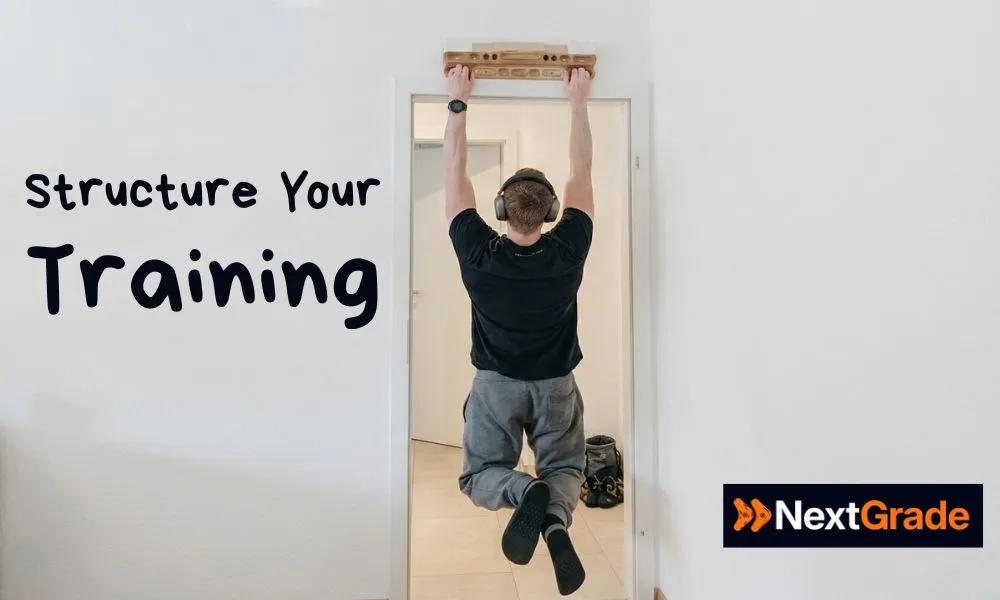
Most climbers don't really train. They climb and if they have something left in the tank at the end of their session they occasionally jump onto a pull-up bar or hangboard. No real structure, no clear intention and no consistency. And that's why you might have been on the same grade for a year or even longer and can't figure out why. That's a climbing plateau. And it usually has nothing to do with effort.
Periodization means planning what you train, in what order, and for how long. Here's why that matters, and what it looks like in practice. I'm going to walk you through how a science-based training plan for climbers looks and why it works. At the end you'll not only understand why pros train like this, but also have a clear picture on how to build your own structured climbing training plan to peak for a trip or simply break your plateau.
How Periodization Works and Why It Matters
Periodization is the planned organization of training over time to maximize performance while minimizing fatigue, injury risk, and plateaus. It shifts training volume, intensity, and exercise specificity across defined phases in order to give your body the best stimulus to achieve your desired climbing outcome.
In climbing and bouldering there are typically these 5 phases:
Base builds the physiological foundation: capillarization, tissue prep, aerobic capacity. Without it, everything that comes later is built on sand.
Strength is where you actually get stronger by creating a stimulus that lets your body grow your muscle fibers. Heavy loads, low reps, long rest. But this is also one of the most common pitfalls: strength alone won't get you far without power. You can't use what you've built if you can't produce it fast enough on the wall.
Power is speed of force production. How fast you can recruit what you've built during the strength phase. It can only be trained effectively after strength, as you're not particularly building more muscle during this phase. You're teaching your muscles how to recruit and produce their force fast (you may have heard of Rate of Force Development). This is what makes pros look like they're flying effortlessly between holds. They're not only super strong. They can generate that power fast when it counts.
Power Endurance takes that strength and power and trains you to sustain it. Done without the base underneath, you're just sustaining mediocre output for longer.
Deload is not a bonus. It's part of the program. Training is stress. Your body adapts during recovery, not during the session itself. Too much stress without recovery is how you plateau, get injured, or burn out.
Important
The order isn't random. Each phase creates the conditions for the next one to work.
Before We Look at the Phases: Why You Can't Skip the Base
In climbing we have an additional hurdle compared to other sports: tendons and connective tissue adapt significantly slower than muscle. Go straight to max hangs without building a base and you end up with stronger muscles pulling on tissue that hasn't caught up. The injury isn't bad luck. It's almost predictable.
But there's a second reason, which is nearly as important:
High-volume aerobic climbing triggers capillarization: your forearm muscles grow new capillaries. More capillaries means better oxygen delivery, faster lactate clearance, quicker recovery between hard moves. Research on climbers directly links forearm capillary density to endurance performance and redpoint ability (Watts et al., 2000; López-Rivera & González-Badillo, 2012).
The same training drives mitochondrial growth: more mitochondria per muscle cell, better aerobic energy production, pump arrives later.
Without that vascular infrastructure, the strength phase can't reach its potential. You'll get stronger. But you'll leave progress on the table.
Not sure where your weaknesses are?
NextGrade tests finger, pull, core and endurance separately to build a plan around your actual numbers.
The Five Phases
Phase 1: Base
High volume, moderate intensity. Around 60–70% of your max. The goal is time under tension at aerobic intensity. Not failure, not fully pumped out. For sport climbers this typically means ARC training: continuous climbing for 20–45 minutes at a comfortable pace (maybe on an auto belay). For boulderers the base phase looks different. "Volume bouldering" well below your limit, repeater circuits at low intensity, general movement.
Nobody posts their base phase to Instagram but this is where the infrastructure gets built and you set yourself up for success. It's also a good time to focus on technique without the pressure of going hard. E.g. if you've been stuck on a bouldering plateau at V3 or V4, skipping this phase is often the actual reason.
Phase 2: Strength
Now you load the system: hangboard sessions at 80–90% of tested max, weighted pull-ups, board sessions near your limit. Fewer reps, heavier loads, longer rest. Three to five minutes between sets, because you're also training the nervous system, not just tiring your forearms.
Phase 3: Power
Strength is how much force you can produce. Power is how fast. The difference shows up constantly on the wall when catching a deadpoint and wide dynamic moves. Typical exercises are campus board work or explosive pull-ups (chest to bar). Keep volume low. High-intensity explosive work creates systemic fatigue that takes longer to clear than forearm pump. Short sessions. More rest than feels comfortable. You leave the gym still feeling fresh, not exhausted.
Phase 4: Power Endurance
Most climbers who have been around for a while accidentally live in this phase permanently. Power endurance climbing sessions feel hard and productive. Interval circuits, 1-on-1-off, 6-in-6. Satisfying, feels like progress. Done without the strength and power base underneath, you're just sustaining mediocre output for longer. Done in the right order, this is where everything from the previous phases comes together. Classic exercises are 4x4 boulder problems or route doubles: climb the same route twice with only one minute of rest.
Phase 5: Performance
This phase is short and often skipped entirely. That's a mistake.
You're not trying to get fitter here. Volume drops sharply. You're climbing at your limit. Projecting at the gym or outside. The fitness you built over the previous weeks is already there. The job now is to access it without pre-exhausting yourself before the crux.
Think of it as letting everything settle. Fewer sessions, lower volume, high intent. This is the phase where the grades actually move.
The Deload Week
Between phases, and depending on age and recovery capacity roughly every 3 or 4 weeks within a phase, comes a week of significantly reduced volume.
Not a rest week exactly, but close. Volume drops by around 40–50%. The body consolidates what it built during the previous block. Without it, fatigue stacks up until performance plateaus or something breaks.
Most climbers have experienced this by accident. Forced rest from injury or work, come back two weeks later feeling inexplicably strong. In theory you could either lower intensity or training volume. Most people report better results with reduced volume, because you're still used to trying hard once the next proper training block starts.
Three Mistakes Worth Naming
I get it. Three minutes of rest between 5–7 second hangs on a fingerboard feel long and boring. But the goal is to create maximum strength and therefore you need to be 100% ready for the next set. Otherwise you'll fatigue way too fast and won't be able to create maximum effort across all sets.
Hint: We're working on a more HIIT-style workout format so these waiting periods get more interesting and your whole training more efficient.
High-rep campus work is endurance training. Keep it explosive and brief, or you're not training power. You're mostly fatiguing your nervous system. That feels very different from exhausting your muscles. Stop as soon as you notice any drop in performance, even if you're still feeling physically fresh.
Rotator cuff, shoulder stability, push exercises: every phase, not as an afterthought. The pulling-to-pushing imbalance in climbing doesn't announce itself. It shows up eight months later as a shoulder impingement that seems to come from nowhere and I can tell this more often than not ruins your climbing for months, not weeks. Pushups are not the best choice to train pushing antagonists. Think overhead presses, rotations, standing Y's and so on. There are plenty of options available for free in our app.
What a 12-Week Plan Actually Looks Like
A full periodized cycle done without time pressure takes 16–18 weeks. In practice, most structured programs, including Lattice's, run 12 weeks. You compress the phases slightly, but it's enough to see real progress.
Here's how we structure a typical 12-week plan at NextGrade:
We have a complex matrix so every exercise is pre-defined for your phase and your level. Endurance, finger, pull and core strength are all tested separately at the start of each plan to identify your weaknesses and create an individual plan.
If you've been stuck at the same grade for a while, the problem probably isn't effort. It's structure. A proper climbing training plan with defined phases fixes what more climbing volume can't.
NextGrade builds your periodized plan from your actual test numbers. Free to use, no coaching fees.
Build your training plan →Sources
- Watts et al. (2000): Forearm capillary density and endurance performance in climbers
- López-Rivera & González-Badillo (2012): Capillarization and redpoint performance in elite climbers
- Frontiers in Physiology (2024): Five weeks of dynamic finger flexor strength training on bouldering performance
- PMC9806751: Effects of climbing- and resistance-training on finger flexor strength
- PMC4637911: Current Concepts in Periodization of Strength Training
- Lattice Training: Training Energy Systems — The Climber's Guide
- Steve Bechtel / climbstrong.com: Variability in Programming
- Modus Athletica: The Climber's Guide to Periodization