
Why I Built NextGrade
(And How It Actually Works)
A 15-year climbing obsession, a ripped A2 pulley, and a frustration with €180 plans that don't bend when life does.
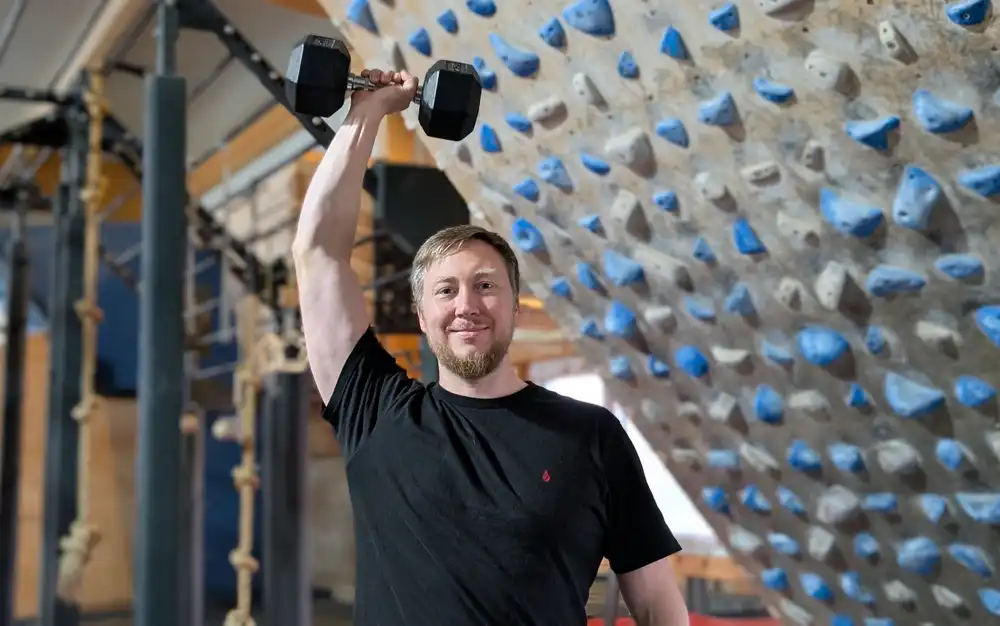
I've been climbing for 15 years now, and for most of that time I was stuck at the same grade. It took me over 3 years to break through from 6C Boulder to 7A. I started climbing in my early twenties and didn't train at all. Gains came quickly and from climbing alone, and I just didn't feel the urge of doing anything else than what I loved most.
Time went by, I had injuries, started kite surfing and eventually ended up with a burn out during an exciting but also very exhausting startup phase. With all of that came frustration. Climbing as hard as I could, 3 times a week, but nothing changed.
This was the time where I decided to pay for a proper training plan — from Lattice Training. And man, I loved it! Expensive, but tailor-made. I trained for 12 weeks and already after the first 4–5 weeks I felt quite a difference on the wall. Not to mention the mental aspects. I was proud of sticking to a training routine for such a long time. But there were drawbacks as well. Some exercises were too hard, others too easy. Some weeks I did not manage to do all of them because of my work schedule, or other private stuff happening. Or occasionally simply wanting to climb with friends I haven't seen for a long time.
After my first Lattice cycle I managed to break my plateau and only a few months later I decided to buy another 12-week plan. But man — this one would end up differently. Starting with the same process: perform a strength test, fill out a Google Form. The result was a plan that was mostly the same as the last one. This was the time I realized the coaches weren't some mystic magicians — they also only take my information, apply scientific (but publicly available) principles like periodization, and select suitable exercises from a given pool for each phase. I was okay with that, as I still was making good progress. Until I ripped my A2 pulley only three weeks later. Plan completely useless.
Back then Lattice had no training app and all the training was done inside the Crimpd app. While recovering from my injury I read and learned a lot about training — climbing-specific and in general — and quickly decided to start building my own plans from then on. Applying the same principles I saw in the €180 plan, using the same app as before. And it worked out great.
So instead of paying for a Lattice plan I was now a pro subscriber to the Crimpd app — €13 a month only to unlock a few additional exercises and workouts. I hate artificial paywalls. In the end it's only an expensive timer. They didn't invent any special exercises that 3x your outcome.
I'm an IT specialist and have a bachelor's degree in UX Design, so when AI became actually practical to use in software development, NextGrade was born. I can build my own timer app, and I can apply a proper plan structure to various types of plans. And as I'm just a passionate climber, doing this all because I want this app for myself and all the other people that are stuck in the sport we all love — I don't need to charge anything.
How It Actually Works
It starts with a handful of quick tests: finger strength, pull strength, core, endurance, and flexibility. Just as you might know from other professional plans — also inspired by the 9c test.
Step 1 — Test your current level
Five numbers, not one grade. Plenty of climbers are strong pullers with weak fingers, or great at endurance but stiff as a board. Lumping all of that into a single "you're intermediate" label throws away exactly the information that actually matters.
Then we compare your results against a broad set of publicly available climbing-strength data to identify potential weak links. We use things like Lattice Training's finger strength research, built from thousands of climbers who've gone through their assessments, alongside similar published benchmarks from Reddit and other online sources. Our own user base is still growing, so right now we lean on data other people have already spent years collecting, instead of pretending we've gathered more than we actually have.
Step 2 — Your plan gets built
Once we know where you stand, your plan gets built around training phases: a base phase, a strength phase, a power phase, working toward a performance phase, with deload periods built in to prevent injuries and overtraining. Every exercise in our library is tagged ahead of time for exactly which phase and which skill level it belongs to — decided by us in advance, not guessed on the spot. The order exercises come in, how much rest sits between hard sessions, how your week balances pulling against pushing: all fixed rules, the same ones a coach would apply by hand.
That basic shape isn't something we invented. It's the same rough sequence you'll find in Lattice's own published training guides, in Steve Bechtel's writing on periodization for climbers, and in coaching frameworks like the one Salt Pump Climbing teaches.
Step 3 — Where AI actually comes in
Only at the very last step does AI get involved, and its job is narrow. By this point your level, your phase, your exercise pool and your whole session structure are already locked in by the rules above. All that's left is picking the specific exercises for today's session out of that already-safe list, and writing the notes that go with them. It can't invent an exercise that isn't on the list. It can't skip a rest rule. It's making one small, well-defined choice inside guardrails someone else already built.
That's on purpose. AI is decent at a narrow decision like this, but I wouldn't trust it to design an entire training plan from a blank page — and neither should you.
The Training Science Behind It
None of this (the phases, the structure, the idea of testing before you train) is something I invented. Periodization has been standard practice in strength training for decades, and climbing coaches have been adapting it to our sport specifically for a long time: Lattice publishes their training frameworks openly, Steve Bechtel's writing on periodization for climbers goes back years, and a widely used five-phase structure (volume, strength, power, power endurance, performance) shows up across multiple respected coaching resources in the climbing world — not just generic gym programming.
Where I'll be straight with you: climbing-specific research is still a smaller field than general strength and conditioning research. There are real, published studies showing measurable finger and grip strength gains from structured training blocks, and newer studies specifically on bouldering performance — but it's a growing pile of evidence, not a mountain of it.
So when I say NextGrade is built on established training principles, that's exactly what I mean: well-tested general training science, adapted carefully to climbing by people who've spent years doing exactly that. Not a claim that every rule in the app has its own peer-reviewed citation behind it. That would be overselling it — and the whole point of this article is not doing that.
Where This Is Going
Right now, AI's job is small on purpose. It only handles that last exercise pick. Down the line, I want it doing more of what it's actually suited for: helping your plan flex around things a fixed rule can't predict — a rough week, a nagging shoulder, a trip with none of your usual equipment. That's a real thing we're building toward, not something I'm going to pretend already exists.
NextGrade is free. No paywall, no locked exercises, no expensive timer. Just a training plan built from your actual numbers.
Try NextGrade →Why I'm Telling You All This
Because you shouldn't have to just take my word for it. NextGrade builds personalized strength training for climbers that actually works: grounded in real training science and your own numbers, built to fit your actual life, and priced so that money is never the reason you don't train properly.
Make every effort count.
Sources & Further Reading
- Lattice Training — published finger strength research & training frameworks
- Salt Pump Climbing Co. — "Five Phases to Maximize Your Potential"
- Steve Bechtel / climbstrong.com — periodization and training structure for climbers
- Modus Athletica — "The Climber's Guide to Periodization"
- PMC4637911 — Current Concepts in Periodization of Strength Training
- PMC9806751 — Effects of climbing- and resistance-training on finger flexor strength/endurance